Memcached: Sicherheit und Kommunikations-Overhead

Als Nachtrag zu dem Lightning Talk vom Samstag möchte ich noch auf diesen Artikel hinweisen, in dem Dustin Sallings, einer der Haupt-Kontributoren von memcached, auf die verschiedenen Möglichkeiten der Absicherung einer memcached-Instanz eingeht.

In einem anderen Artikel sagt Brad Fitzpatrick, der ursprüngliche Autor von memcached, auf Seite Zwei wörtlich: "Each Memcached instance is totally independent, and does not communicate with the others.". Mit anderen Worten: Die Instanzen kommunizieren nicht mit einander, es ist also Aufgabe der Client-Library, die einzelnen Instanzen zu befragen.

Für weitere Fragen und Anmerkungen stehe ich natürlich gern zur Verfügung. Ich bedanke mich nochmals bei allen Zuhörern vom Samstag für die Aufmerksamkeit und hoffe, ich konnte einen groben Überblick geben.

Die Slides zum Talk sind auf dieser Seite des Wiki zu finden.

Software Freedom Day 2010

Die Java Usergroup Münster lädt zum Software Freedom Day 2010 ein.
In Zusammenarbeit mit der Google Technology Usergroup Münster und dem Warpzone e.V. verstanstalten wir in Münster den Software Freedom Day am 11. September 2010. Bei dem ganztägigen Event wird es Vorträge zu verschiedenen Themen, wie z.B. "Softwarepatente", "Entwicklung mit freier Software" und rund um Chancen und Einsatz von freier Software geben.

Neben den Vorträgen und Lightning-Talks wird es auch ausreichend Zeit für Diskussionen und gegenseitige Unterstützung bei "hands-on" Aktivitäten geben.

Weiterlesen »

Stammtisch 01.09.2010 im Cuba-Nova

Der naechste Java Stammtisch findet am 01.09.2010 im Cuba Nova ab 18:30 Uhr statt. Eingeladen sind wie immer alle an Java, Softwareentwicklung und Projektmanagement interessierten Personen.

Hinweis: Wir haben eine neue Mailingliste, wer per E-Mail auf dem Laufenden gehalten werden möchte, kann sich mit einer E-Mail an jug-join@list.jug-muenster.de eintragen.

Weiterlesen »

WJAX 2010: 15.-19. November

Die W-JAX ist die Konferenz für ganzheitliches technisches Know-how im Java- und Webumfeld. Das breite Themenspektrum der W-JAX bietet eine Fülle an Wissen, das benötigt wird, um komplexe Softwareentwicklungsprojekte effizienter und erfolgreicher zu realisieren. Es reicht von Java-Core-Themen über Entwicklungstechniken und Tools bis hin zu Architektur und agilen
Vorgehensweisen.
Neben Vorträgen zu technischen- und methodischen Themen gibt es auf der WJAX auch Gelegenheit zum Networking und Erfahrungsaustausch.

Das komplette Programmangebot ist unter www.jax.de ersichtlich.

SteelSeries Java Swing component library

Here we go again...

A few months ago i started a new project where i again focussed on gauges (i love that stuff). It took me some time because i only work on the project on my spare time (which is rare) but now i finished a first version of a little library that contains a lot of gauges for Java applications...

First of all i have to mention that this library was not meant to be a professional components library and should not be used on mission critical software. Means if you use the library it's on your own risk !

I've never before created a component library and for me it was and is a great challenge to dive deeper into the Java universe...

But now let's have some fun...

The library contains two general types of gauges, radial and linear ones and some little candy in the form of additional components like a Radar component etc.

I add some properties to the gauges that hopefuly will be useful for some of you.

Here is a short list of the most interesting features:

  • frameDesign (metal, shiny metal, blackmetal)
  • backgroundColor (dark gray, light gray, white, black, beige, red, green blue)
  • pointer/bar color (red, green, blue, yellow, orange)
  • a three colored track to visualize areas of special interest (e.g. a critical temperature range)
  • thresholdIndicator
  • blinking threshold led (red, green, blue, orange, yellow)
  • adjustable tickmarks
  • indicators for min. and max. measured values
  • auto reset to zero feature

It should be possible for you to create your own components out of these library and  if you'll take a look at the source you will find components like Radial1Lcd, Radial2Lcd and Radial3Lcd where i used Netbeans matisse gui builder to create the component from the FrameCircular and DisplaySingle components.

So you should be able to check read the sourcecode of these components and see how i did it (the easiest way would be to use Netbeans to check the source).

But to give you a impression, let pictures speak...

Weiterlesen »

Stammtisch: 4.8. im Cuba Nova

Der naechste Java Stammtisch findet am 4.8. im Cuba Nova ab 18:30 Uhr statt. Eingeladen sind wie immer alle an Java, Softwareentwicklung und Projektmanagement interessierten Personen.

Hinweis: Wir haben eine neue Mailingliste, wer per E-Mail auf dem Laufenden gehalten werden möchte, kann sich mit einer E-Mail an jug-join@list.jug-muenster.de eintragen.

Weiterlesen »

30.7.: Clojure Presentation with Alex Ott

Clojure is a language running on the Java Virtual machine and gaining rapid popularity. Beeing a general-purpose language supporting interactive development that encourages a functional programming style, and simplifying multithreaded programming its usage is particularly promising in high concurrency/throughput environments.

Weiterlesen »

Java2D Conical Gradient Paint

Just a short blogpost about a little tool that i would like to share with you...
A few months ago i was creating a worldclock with a night and day display where i needed a conical gradient.
So what is a conical gradient ? Here we go...

Weiterlesen »

JUG Stammtisch am 21.7.

Am Mittwoch dem 21.7. gibt es wieder den offenen Stammtisch der JUG Muenster!

Hinweis: Wir haben eine neue Mailingliste, wer per E-Mail auf dem Laufenden gehalten werden möchte, kann sich mit einer E-Mail an jug-join@list.jug-muenster.de eintragen.

Weiterlesen »

Android AutoConversion EditText component

AutoConversion EditText component:

Yesterday i created a Java Swing textfield component that autoconverts a given value into a selectable unit which could be useful.

In the evening i got the idea to port this component to Android and see if it will work there.

Just as a short note...if you are a Java developer you should take a look into Android...it's sooooo nice, porting the component tooks me not more than 2 hours (and i'm not really into Android development).

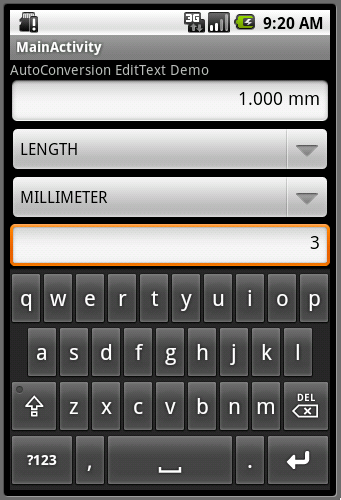
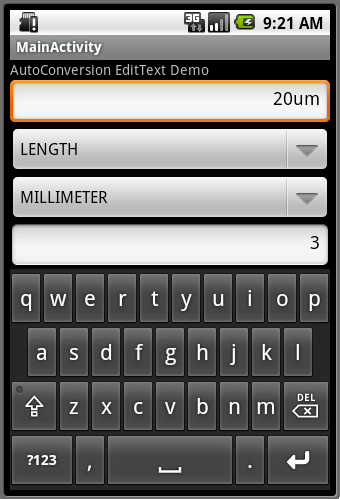
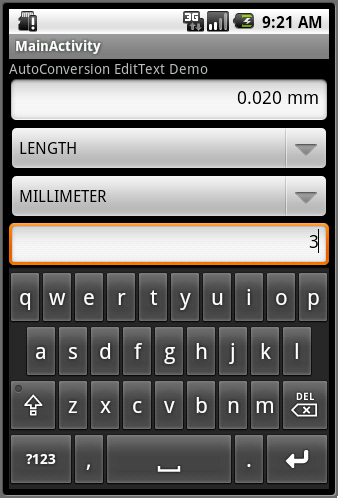
Here is the result:

ishot-2.pngishot-3.pngishot-4.png


So you could type in a value with the unit of your choice and after leaving the field the value will be converted into the EditText "base unit".

I changed the units with special characters like µ, Å, ² and ³ to u, A, 2 and 3 which leads to units like:

um  <=>  µm

A <=>  Å

m2  <=>  m²

m3  <=>  m³

and so on...

The upper spinner will select the type of unit you would like to use.

The middle spinner will select the current base unit for the textfield.

The lower spinner will adjust the number of decimals for the textfield.

Because it displays the unit directly in the textfield there's no need for a additional label for the unit.

You also might check this little video

Well again this is nothing very fancy or gui related but it was a nice challange for me so i decided to share it with you... AutoConversionField.zip


follow me on twitter if you like...


Java AutoConversion textfield component

AutoConversion textfield component:

If you drive a motorized stage of a microscope you often have to handle coordinates in a unit like millimeter [mm]. But it might happen that the sample in your microscope is only in the range of microns [µm].

So would it not be nice to directly type in the coordinates in µm and the textfield would automaticaly convert the unit into [mm] ?

This would increase the workflow a lot because you do not have to think about conversion of units. There seems to be countries that are using inches and people living there might like to type in coordinates in inches instead of millimeters..etc...

For this reason i created a little component that extends a standard javax.swing.JTextField and is now able to do the conversion. You could also use the conversion alone without the textfield to create some kind of unit converter...it's up to you.

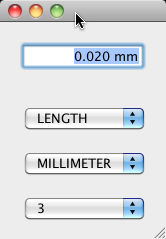
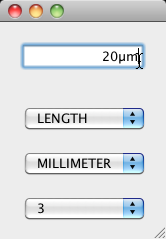
Here are a few screenshots of a demo app that uses the component:
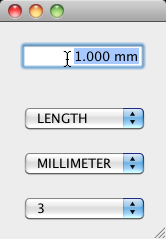
#1 Step

#3 Step#2 Step

So you could type in a value with the unit of your choice and after leaving the field or pressing enter the value will be converted into the textfields "base unit".

The upper combobox will select the type of unit you would like to use (it supports angle, area, length, mass, temperature, time at the moment but one could easily add more units to it).

The middle combobox will select the current base unit for the textfield.

The lower combobox will adjust the number of decimals for the textfield.

Because it displays the unit directly in the textfield there's no need for a additional label for the unit.

You also might check this little video

Well this is nothing very fancy or gui related but it was very useful for me so i decided to share it with you... ConversionField.zip


follow me on twitter if you like...

JavaOne: 200$ JUG Rabatt

Die JavaOne 2010 findet vom 19 bis 23 September in San Francisco statt. Zum ersten Mal wird die JavaOne unter der Schirmherrschaft von Oracle veranstaltet. Und Oracle bietet auch etwas ganz besonderes: Für Mitglieder einer Java Usergroup gibt es einen 200$ Sonderrabatt!
Und dieser Rabatt gilt zusätzlich zum regulären Frühbucherrabatt - kann aber auch noch später geltend gemacht werden.

Weiterlesen »

Java Stammtisch: 23.6. ab 18:30 Uhr

Wir möchten zum nächsten Java Stammtisch in Münster einladen! Herzlich willkommen sind alle an Java und Softwareentwicklung interessierten Personen. (Damit sind auch PHP, Ruby on Rails, .NET und Scala Entwickler gemeint :-) ) In entspannter Atmosphäre gibt es Gelegenheit zum gegenseitigen Austausch, Kennenlernen oder auch Diskussionen beizuwohnen.

Hinweis: Wir haben eine neue Mailingliste, wer per E-Mail auf dem Laufenden gehalten werden möchte, kann sich mit einer E-Mail an jug-join@list.jug-muenster.de eintragen.

Weiterlesen »

Kritische Sicherheitslücke im Spring Framework

Spring Source hat mit CVE-2010-1622 auf eine kritische Sicherheitslücke im Spring Framework aufmerksam gemacht. Die von Meder Kydyraliev, Google Security Team gefundene Lücke ist seit April bekannt und wurde mit dem Release Spring Framework 3.0.3 gefixt. (Dieses Release wurde jedoch nicht als sicherheitskritisch gekennzeichnet und das Problem könnte so leicht übersehen werden!)

Weiterlesen »